
Unlike product packaging trade dress, which can be inherently distinctive, product configuration trade dress is not inherently distinctive because consumers are not predisposed to equate such configurations with particular sources: “even the most unusual of product designs − such as a cocktail shaker shaped like a penguin − is intended not to identify the source, but to render the product itself more useful or more appealing.” Wal-Mart Stores Inc. v. Samara Bros. Inc., 529 U.S. 205, 213 (2000); see also In re Slokevage, 441 F.3d 957, 961 (Fed. Cir. 2006); In re Change Wind Corp., Serial No. 86046590, 2017 TTAB LEXIS 233, at *32 (TTAB 2017). Hence, product configurations may be registered as marks only upon a showing of acquired distinctiveness. See, e.g., Slokevage, 441 F.3d at 961; AS Holdings, Inc. v. H & C Milcor, Inc., Opp. No. 91182064, 2013 TTAB LEXIS 388, at *28 (TTAB 2013); In re UDOR U.S.A., Inc., Serial No. 78867933, 2009 TTAB LEXIS 61, at *25-26 (TTAB 2009).
To establish acquired distinctiveness, one must demonstrate that the relevant members of the public (such as purchasers or users, or potential customers of the product) understand the primary significance of the applied-for product configuration as identifying the source of the product rather than the product itself. Inwood Labs., Inc. v. Ives Labs., Inc., 456 U.S. 844, 851 n. 11 (1982); In Re MGA Entm't, Inc., Serial No. 76603323, 2007 TTAB LEXIS 78, at *11 (TTAB 2007). This burden is particularly heavy where an applicant seeks to establish the distinctiveness of a product configuration, which consumers are predisposed to view as useful or appealing, not source-indicating. Yamaha Int'l. Corp. v. Hoshino Gakki Co. Ltd., 840 F.2d 1572, 1581 (Fed. Cir. 1988); In re Ennco Display Sys., Inc., Serial No. 74439206, 2000 TTAB LEXIS 235, at *14 (TTAB 2008) (“While there is no fixed rule for the amount of proof necessary to demonstrate acquired distinctiveness, the burden is heavier in this case because it involves product configurations.”).
Evidence to support a claim of acquired distinctiveness may fall into two general categories: direct evidence and circumstantial evidence. See Schlafly v. St. Louis Brewery, LLC, 909 F.3d 420, 424 (Fed. Cir. 2018) (“both direct and circumstantial evidence may show secondary meaning”); Kohler Co. v. Honda Giken Kogyo K.K., Opp. No. 91200146, 2017 TTAB LEXIS 450, at *122 (TTAB 2017) (“Direct evidence includes actual testimony, declarations or surveys of consumers as to their state of mind. Circumstantial evidence is evidence from which consumer association may be inferred, such as years of use, extensive amounts of sales and advertising, and any similar evidence showing wide exposure of the mark to consumers.”); see also Converse, Inc. v. Int'l Trade Comm'n, 909 F.3d 1110, 1120 (Fed. Cir. 2018)) (“(1) association of the trade[mark] with a particular source by actual purchasers (typically measured by customer surveys); (2) length, degree, and exclusivity of use; (3) amount and manner of advertising; (4) amount of sales and number of customers; (5) intentional copying; and (6) unsolicited media coverage of the product embodying the mark.”). No single type of evidence is determinative, but “[t]he evidence must relate to the promotion and recognition of the specific configuration embodied in the applied-for mark and not to the goods in general.” Change Wind, 2017 TTAB LEXIS 233, at *33.
It also is well-settled that where “a party's advertising and sales data is based on materials and packaging in which the mark at issue is almost always displayed with another mark, such data does not prove that the mark at issue possesses the requisite degree of consumer recognition.” ProMark Brands Inc. v. GFA Brands, Inc., Opp. No. 91194974, 2015 TTAB LEXIS 67, at *43 (TTAB 2015) (citing Bongrain Int'l (Am.), 894 F.2d at 1318); see also In re Mogen David Wine Corp., 372 F.2d 539, 541 (CCPA 1967) (promotion of a bottle design bearing other trademarks insufficient to show that the public views the bottle design alone as a trademark); In re Soccer Sport Supply Co., 507 F.2d 1400, 1403 (CCPA 1975) (advertising of soccer ball design with word marks “provide[s] no indication of a nexus between [the] design per se and a single source”).
The length of time needed to acquire distinctiveness in the mind of the consuming public is proportional to the non-distinctiveness of the applied-for mark. See UDOR U.S.A., 2009 TTAB LEXIS 61, at *26-27 (“We also agree with the Trademark Examining Attorney that given the nature of this alleged mark, a mere claim of five years of use is insufficient to overcome this showing. Analogizing to the possible registrability of highly descriptive terms which may nevertheless acquire distinctiveness, we note that the lesser the degree of inherent distinctiveness, the heavier the burden to prove it has acquired distinctiveness.”); see also In re Van Valkenburgh, Serial No. 77025789, 2011 TTAB LEXIS 1, at *29-30 (TTAB 2011) (sixteen years' use insufficient to show acquired distinctiveness for motorcycle stands); Mag Instrument Inc. v. Brinkmann Corp., Opp. No. 91163534, 2010 TTAB LEXIS 322, at *68 (TTAB 2010) (twenty-seven years' use insufficient to show acquired distinctiveness for dual bands on flashlight); In re Howard Leight Indus. LLC, Serial No. 76439661, 2006 TTAB LEXIS 229, at *34 (TTAB 2006) (fifteen years' use insufficient to show acquired distinctiveness for earplug configuration); In re Gibson Guitar Corp., Serial No. 75513342, 2001 TTAB LEXIS 835, at *9-10 (TTAB 2001) (sixty-six years' use insufficient to show acquired distinctiveness for guitar configuration); cf. In re R.M. Smith, Inc., 734 F.2d 1482, 1485 (Fed. Cir. 1984) (eight years' use insufficient to show acquired distinctiveness for pistol grip water nozzle configuration).
The TTAB recently upheld a refusal to register the configuration for a "light emitting diode (LED) apparatus for lighting, incorporated into medical instruments," on the ground that Applicant Translite failed to prove that the design had achieved acquired distinctiveness; notwithstanding 18 years of use of sales of the LED product. In re Translite, LLC, Ser. No. 97925710 (July 10, 2025) (not precedential). Notably, functionality was not at issue on appeal.
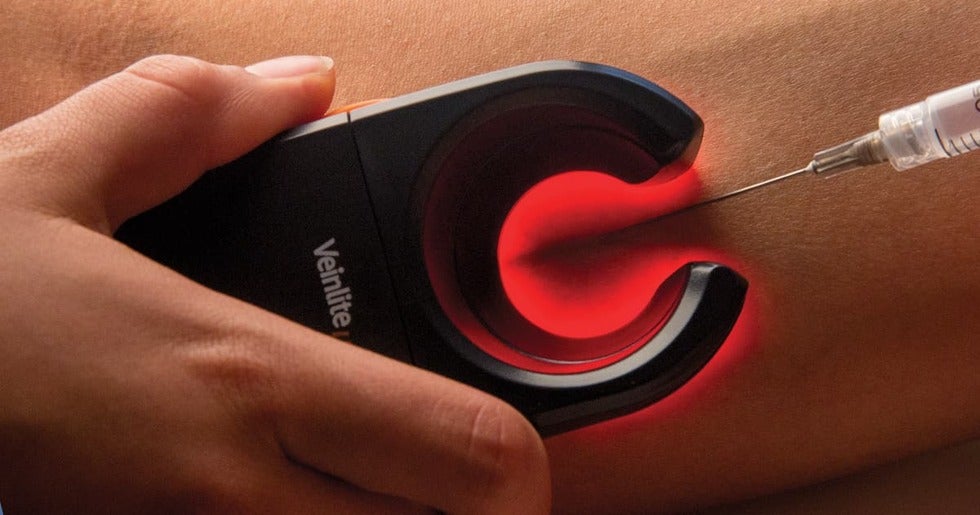
The mark was described as consisting of:
a three-dimensional configuration of a device consisting of a rectangular base that extends up to a curved top, resembling a sideways letter “C”. Below the “C” is a design of an eye with a line through it, and on the side of the device is a button. The features rendered in dotted lines are not claimed as part of the mark.
Eighteen years of use since 2006 with sales of the product resulting in $1.61 million in annual revenue was found to be insufficient in this case to establish acquired distinctiveness. The TTAB stated that "[b]ecause the applied-for mark in this case is a product configuration, which consumers may appreciate for its utility or appearance rather than its putative indication of source, a showing of five or more years' use is insufficient," citing In re Koninklijke Philips Elecs. N.V., Serial No. 85092079, 2014 TTAB LEXIS 349, at *16 (TTAB 2014).
Other evidence including four identically-worded declarations also was not found persuasive.
At bottom, the critical question is not the length of Applicant's use, the dollar amount of its sales, or the extent of its advertising; it is the effectiveness of these efforts in “creating a consumer association between the product configuration and the producer.” Ennco Display Sys., 2000 TTAB LEXIS 235, at *19. Based on consideration of all of the evidence of record, and having considered the relevant factors, we find that Applicant has failed to satisfy its burden of proving acquired distinctiveness under Section 2(f) of the Trademark Act.
Accordingly, the TTAB held that that the applied-for mark was a nondistinctive product configuration that has not acquired distinctiveness.

Comments
There are no comments for this post. Be the first and Add your Comment below.
Leave a Comment