
A meme is an amusing or interesting item (such as a picture or video, often captioned) that is spread widely online especially through social media. See Merriam-Webster Online Dictionary (accessed May 19, 2024).
One well-known meme is “Success Kid” which is a photo that Laney Griner took of her then 11-month-old son (Sam) making a fist-pump pose in 2007.
The 2020 reelection campaign committee for then-Congressman Steve King used the “Success Kid” photo in a Facebook post captioned with the words, “FUND OUR MEMES!!!”
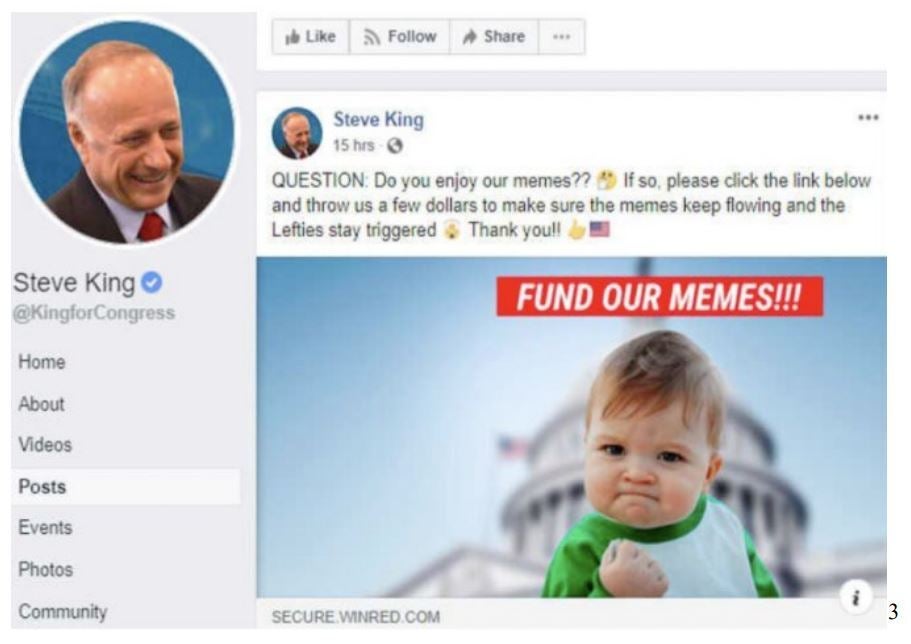
Griner sued the Congressman and his reelection committee for copyright infringement, and won $750 in damages from the reelection committee.
On appeal, the Eighth Circuit affirmed, finding that this was copyright infringement and not fair use. Griner v. King, No. 22-3623, — F.4th — (8th Cir. Jun. 7, 2024).
Memes used commercially in advertising or fundraising are subject to stricter copyright standards than memes used noncommercially, which are often fair use.
***
[I]t is undisputed that the Committee's use was purely commercial—the meme solicited campaign donations with its call to “FUND OUR MEMES!!!” The Committee sought to exploit the copyrighted material, for financial gain, without paying the customary price
***
The Committee's stated justification is that they were creating and disseminating a meme on social media, as happens millions (if not billions) of times each day. “[T]he fact that everyone else is doing it” is not a particularly compelling justification, especially considering the vast majority of these uses are non-commercial.
Whether an unauthorized use of a copyrighted work constitutes fair use, four statutory factors are considered: “(1) the purpose and character of the use, including whether such use is of a commercial nature or is for nonprofit educational purposes; (2) the nature of the copyrighted work; (3) the amount and substantiality of the portion used in relation to the copyrighted work as a whole; and (4) the effect of the use upon the potential market for or value of the copyrighted work.” Campbell v. Acuff-Rose Music Inc., 510 U.S. 569, 577 (1994) (quoting 17 U.S.C. § 107); see also Andy Warhol Found. for the Visual Arts, Inc. v. Goldsmith, 143 S. Ct. 1258 (2023).
The Court found that the first fair-use factor, nature of use, favored Griner.
It was undisputed that the second factor also favored Griner.
The third factor favored Griner because the heart of the work, namely, Sam's image, was taken.
The fourth factor was neutral because “it is difficult to determine what impact the Committee's use of the Success Kid template had on its commerciality.”
Professor Goldman noted that this decision reflects a simple rule: “meme usage for noncommercial purposes is likely fair use, while meme usage in ads isn't. Another example of advertising exceptionalism.”
The copyright attorneys at Thomas P. Howard, LLC can evaluate copyright issues including whether the alleged use is actionable.

Comments
There are no comments for this post. Be the first and Add your Comment below.
Leave a Comment